New Project

Modifying Request Headers in Middleware

Learn to add/update/delete request headers in a middleware.

DeployView Demo

Add Header Example

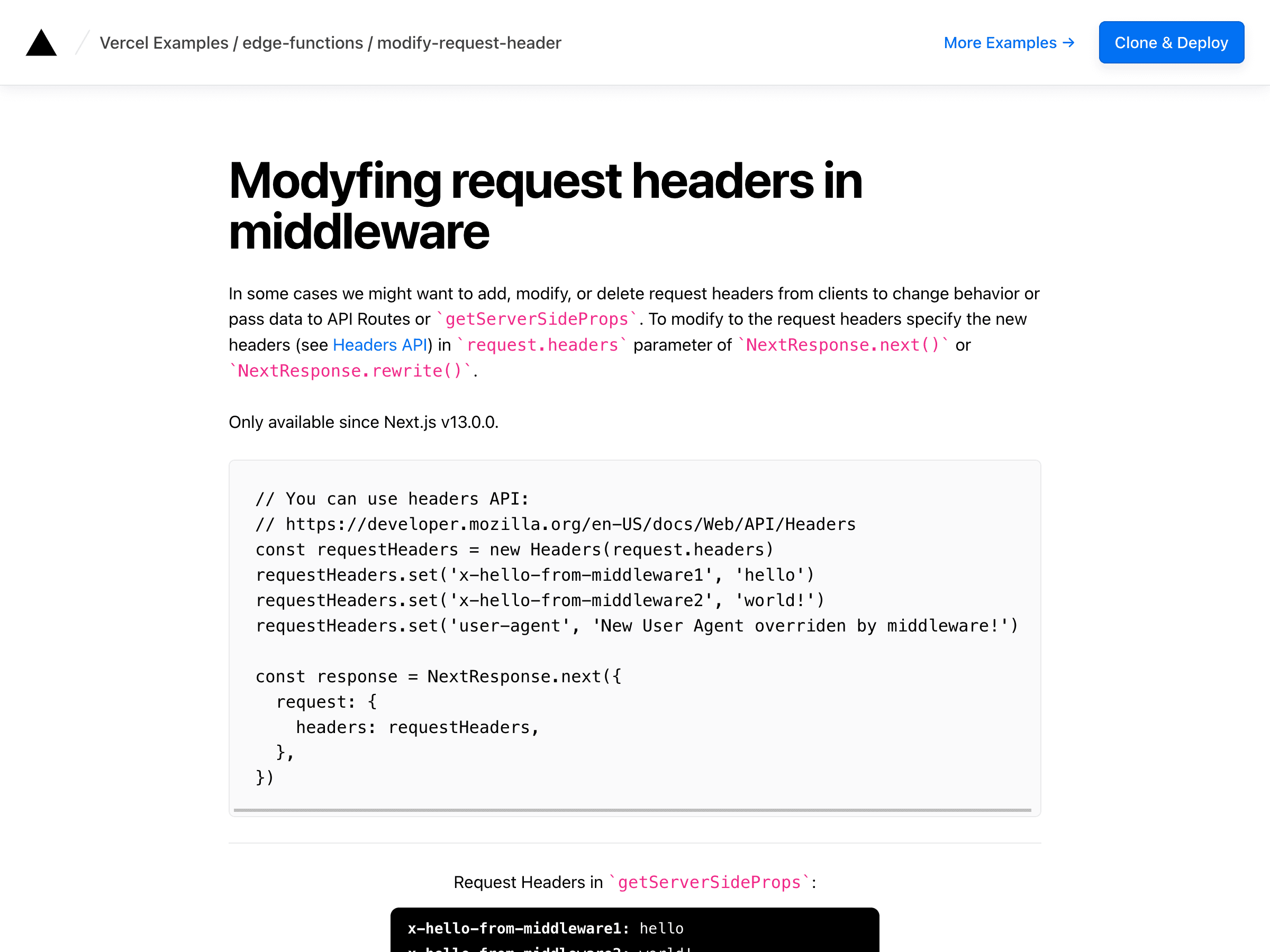
Below is the code from middleware.ts [blocked] showing how to add/update/delete headers in a middleware (available since Next.js v13.0.0):

import { NextResponse } from 'next/server'
import type { NextRequest } from 'next/server'
export default function middleware(request: NextRequest) {
// Clone the request headers
// You can modify them with headers API: https://developer.mozilla.org/en-US/docs/Web/API/Headers
const requestHeaders = new Headers(request.headers)
// Add new request headers
requestHeaders.set('x-hello-from-middleware1', 'hello')
requestHeaders.set('x-hello-from-middleware2', 'world!')
// Update an existing request header
requestHeaders.set('user-agent', 'New User Agent overriden by middleware!')
// Delete an existing request header
requestHeaders.delete('x-from-client')
// You can also set request headers in NextResponse.rewrite
return NextResponse.next({
request: {
// New request headers
headers: requestHeaders,
},
})
}

Demo

https://edge-middleware-modify-request-header.vercel.app

How to Use

You can choose from one of the following two methods to use this repository:

One-Click Deploy

Deploy the example using Vercel:

Clone and Deploy

Execute create-next-app with pnpm to bootstrap the example:

pnpm create next-app --example https://github.com/vercel/examples/tree/main/edge-middleware/modify-request-header modify-request-header

Next, run Next.js in development mode:

pnpm dev

Deploy it to the cloud with Vercel (Documentation).

GitHub Repovercel/examples
LicenseView License
Use Cases
Edge Middleware
Stack
Next.js
Tailwind

Related Templates

Adding Response Headers in Edge Middleware

Learn to add response headers at the edge.
Adding Response Headers in Edge Middleware thumbnail
DeployView Demo