Global network and regions
Vercel's CDN is a globally distributed platform that stores content and runs compute close to your users and data, reducing latency and improving performance. This page details the supported regions and explains our global infrastructure.
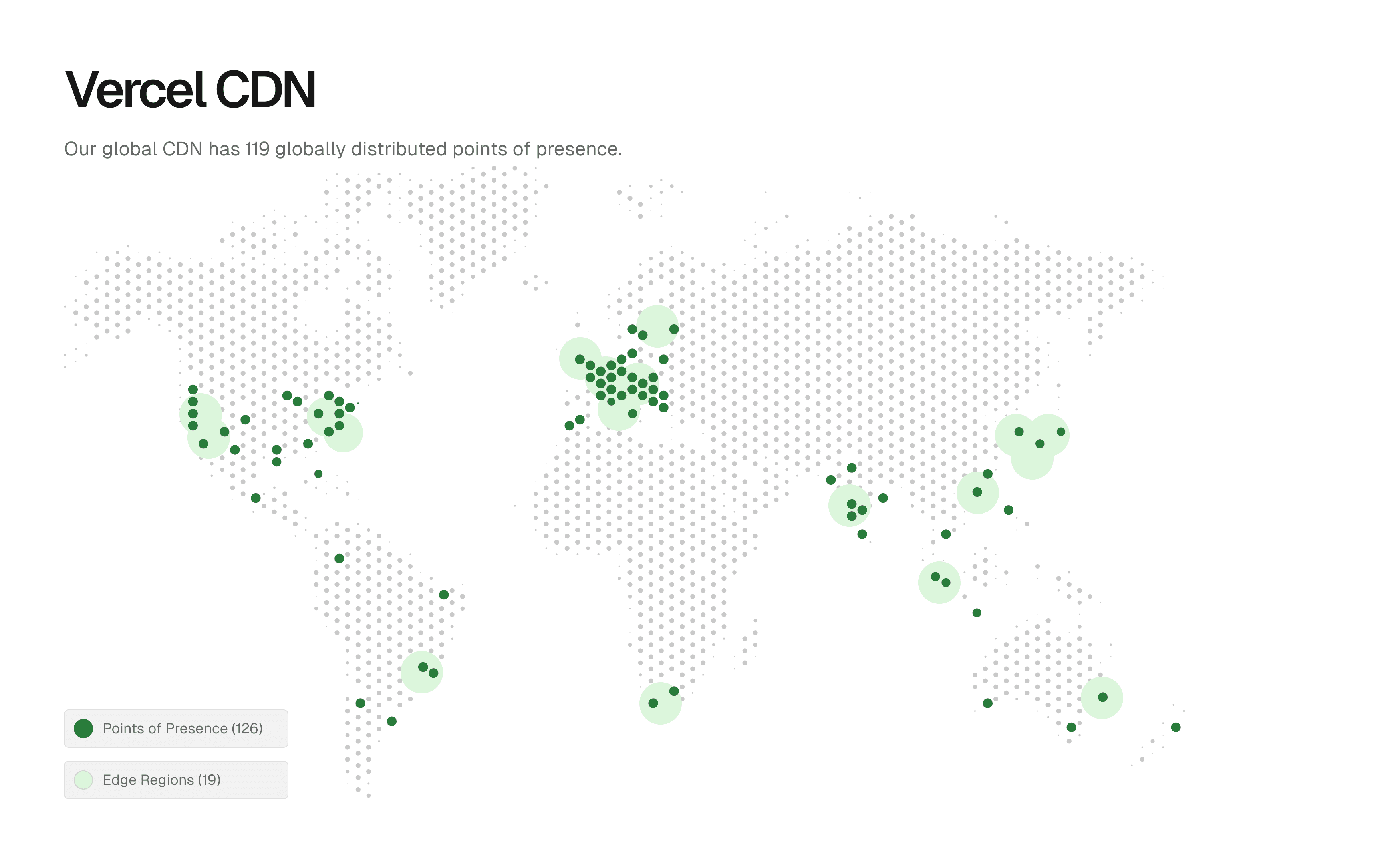

Vercel's CDN is built on a sophisticated global infrastructure designed to optimize performance and reliability:
- Points of Presence (PoPs): We operate over 126 PoPs distributed across the globe. These PoPs serve as the first point of contact for incoming requests, ensuring low-latency access for users worldwide.
- Vercel Regions: Behind these PoPs, we maintain 19 compute-capable regions where your code can run close to your data.
- Private Network: Traffic flows from PoPs to the nearest region through private, low-latency connections, ensuring fast and efficient data transfer.
This architecture balances the benefits of widespread geographical distribution with the efficiency of concentrated caching and compute resources.
Our approach to caching is designed to maximize efficiency and performance:
- By maintaining fewer, dense regions, we increase cache hit probability. This means that popular content is more likely to be available in each region's cache.
- The extensive PoP network ensures that users can quickly access regional caches, minimizing latency.
- This concentrated caching strategy results in higher cache hit ratios, reducing the need for requests to go back to the origin server and significantly improving response times.
Region Code | Region Name | Reference Location |
|---|---|---|
| arn1 | eu-north-1 | Stockholm, Sweden |
| bom1 | ap-south-1 | Mumbai, India |
| cdg1 | eu-west-3 | Paris, France |
| cle1 | us-east-2 | Cleveland, USA |
| cpt1 | af-south-1 | Cape Town, South Africa |
| dub1 | eu-west-1 | Dublin, Ireland |
| fra1 | eu-central-1 | Frankfurt, Germany |
| gru1 | sa-east-1 | São Paulo, Brazil |
| hkg1 | ap-east-1 | Hong Kong |
| hnd1 | ap-northeast-1 | Tokyo, Japan |
| iad1 | us-east-1 | Washington, D.C., USA |
| icn1 | ap-northeast-2 | Seoul, South Korea |
| kix1 | ap-northeast-3 | Osaka, Japan |
| lhr1 | eu-west-2 | London, United Kingdom |
| pdx1 | us-west-2 | Portland, USA |
| sfo1 | us-west-1 | San Francisco, USA |
| sin1 | ap-southeast-1 | Singapore |
| syd1 | ap-southeast-2 | Sydney, Australia |
| yul1 | ca-central-1 | Montréal, Canada |
For information on different resource pricing based on region, see the regional pricing page.
In addition to our 19 compute-capable regions, Vercel's CDN includes 126 PoPs distributed across the globe. These PoPs serve several crucial functions:
- TCP termination and routing: PoPs terminate TCP and route requests over a private network to the nearest Vercel region with single-digit millisecond latency.
- DDoS protection: They provide a first line of defense against distributed denial-of-service attacks.
- TLS termination: The Vercel region the request is routed to handles TLS encryption and decryption.
The extensive PoP network ensures that users worldwide can access your content with minimal latency, even if compute resources are concentrated in fewer regions.
Vercel has no regions or Points of Presence in mainland China. Sites hosted on Vercel can load slowly or fail to load for visitors there, and Vercel can't guarantee availability or performance in mainland China.
Three factors limit access:
| Cause | What it means for your site |
|---|---|
| No infrastructure in mainland China | Requests from mainland China travel to Vercel infrastructure outside it, which adds latency |
| Network controls | China's network controls, often called the Great Firewall, can block or throttle traffic to domains hosted outside the country, including .vercel.app domains. Traffic that isn't blocked still passes through international gateways, which slows connections. Blocking applies per domain, can differ between internet service providers, and can change without notice |
| Licensing | Hosting a site in mainland China requires an Internet Content Provider (ICP) license. Vercel doesn't offer hosting in mainland China or support for ICP licensing |
A site hosted outside mainland China can't be made reliably reachable there, but these approaches reduce slow and blocked requests. They are listed from least to most effort:
| Approach | Infrastructure changes | ICP license required | Trade-offs |
|---|---|---|---|
| Use a custom domain | None | No | Least effort, but the domain can still be blocked |
| Self-host third-party resources | Minimal | No | Removes dependencies on services that are blocked in mainland China |
| Deploy a static mirror outside mainland China | A second deployment target | No | Routing can improve, but you maintain two builds |
| Deploy a separate version in mainland China | Hosting in mainland China | Yes | Most reliable access, with the most compliance and maintenance work |
- Use a custom domain: Add a custom domain to your project and share that domain instead of the
.vercel.appdomain. A custom domain is less likely to be blocked than a.vercel.appdomain. - Self-host third-party resources: Fonts, analytics scripts, and other resources loaded from services that are blocked in mainland China can stall a page that is otherwise reachable. Serve those files from your own domain. In Next.js,
next/fontdownloads font files at build time and serves them with your deployment. - Deploy a static mirror outside mainland China: Deploy a static copy of your site to infrastructure with more reliable routing into mainland China. Vercel doesn't recommend placing a reverse proxy in front of your Vercel project to do this.
- Deploy a separate version in mainland China: Run a separate version of the site on hosting infrastructure in mainland China. This gives visitors there the most reliable access, but requires an ICP license and a second site to maintain.
Start with a custom domain and self-hosted resources, because neither needs new infrastructure. Consider a mirror or a deployment in mainland China when reliable access there is a business requirement.
When you use the vercel dev CLI command to mimic your deployment environment locally, the region is assigned dev1 to mimic the Vercel platform infrastructure.
| Region Code | Reference Location |
|---|---|
| dev1 | localhost |
- Vercel Functions default to running in the
iad1(Washington, D.C., USA) region. Learn more about changing function regions
Functions should be executed in the same region as your database, or as close to it as possible, for the lowest latency.
Vercel's CDN is designed with high availability and fault tolerance in mind:
- In the event of regional downtime, application traffic is automatically rerouted to the next closest region. This ensures that your application remains available to users even during localized outages.
- Traffic will be rerouted to the next closest region in the following order:
Regions by priority
- For Enterprise customers, Vercel functions can automatically failover to a different region if the region they are running in becomes unavailable. Learn more about Vercel Function failover.
This multi-layered approach to resiliency, combining our extensive PoP network with intelligent routing and regional failover capabilities, ensures high availability and consistent performance for your applications.
Was this helpful?